Marine fenders are among the most important components of any berthing infrastructure. Although they often go unnoticed compared with other, more visible port installations, they play a fundamental role in ensuring the safety of both vessels and port structures during approach, berthing and mooring operations, as well as while vessels remain alongside the quay.
Their main function is to absorb the energy generated during contact between the vessel and the infrastructure, reducing the forces transmitted to both the vessel’s hull and the port structure itself. Proper fender selection helps minimise damage, extend the service life of port facilities and improve the safety of marine operations.
The choice of fender type depends on numerous factors, including the size and type of vessels using the berth, approach velocity, environmental conditions, quay configuration and the specific operational requirements of the terminal.
Among the highest-performance solutions are Cone Fenders and Super Cell Fenders, specifically designed for port terminals with demanding operational requirements. Their geometry optimises the relationship between energy absorption and the reaction force transmitted to the structure, while both types provide excellent performance under repeated impacts and angular loads. They are particularly recommended for commercial terminals, cargo terminals, cruise terminals and other berths handling large vessels.
Fender panels are a fundamental component of high-performance fender systems, such as Cone and Super Cell Fenders. Typically manufactured from structural steel and fitted with UHMW-PE facing pads, they distribute loads evenly over the vessel’s hull, reduce contact pressures and improve performance during berthing manoeuvres. Their design can be adapted to different dimensions, geometries and quay configurations, facilitating the berthing of vessels of different sizes and draughts.
V-Fenders provide a robust and versatile solution for a wide range of berthing configurations. Their design offers high energy absorption capacity with controlled reaction forces on the structure, making them a widely used solution in commercial and fishing ports, marinas and other facilities requiring a reliable, durable and low-maintenance fender system.
Cylindrical Fenders are one of the most widely used solutions in port applications due to their simplicity, robustness and excellent performance under repeated impacts. They are commonly used on commercial, fishing and industrial quays, service berths and dolphins, and are particularly suitable for installations with low to moderate tidal ranges where fender panels are not required. Their excellent balance of performance, durability and cost makes them one of the most widely used fender types worldwide.
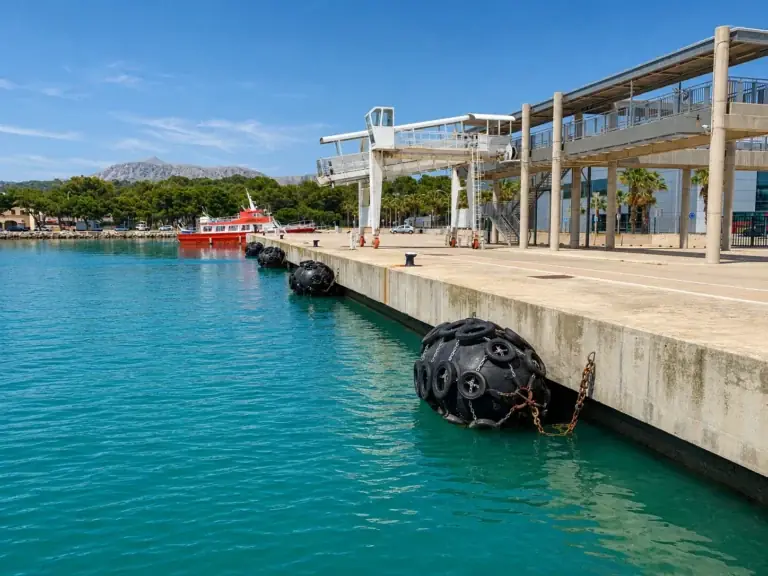
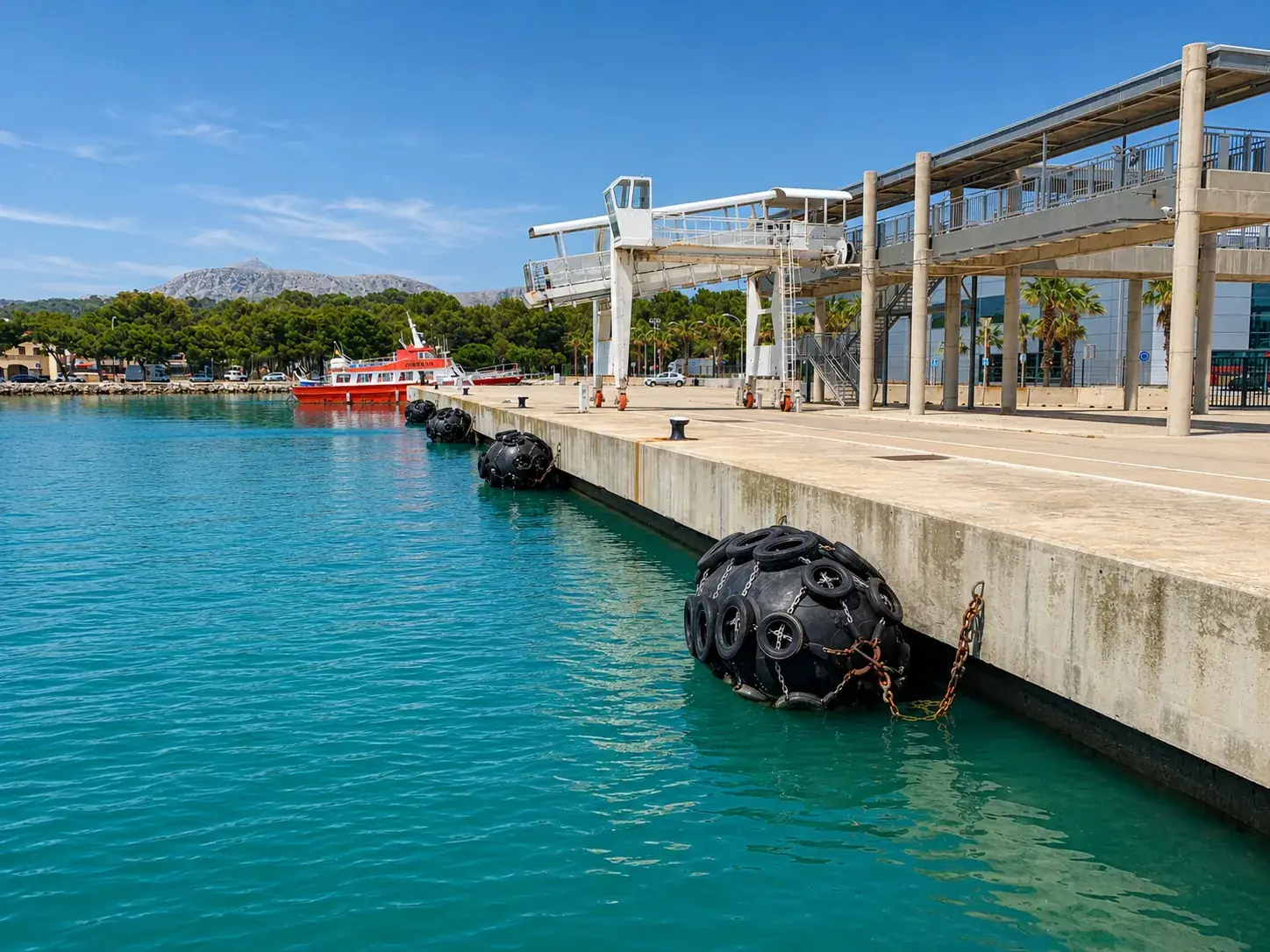
For applications with more demanding operational requirements, Floating Pneumatic Fenders (Yokohama Fenders) are also available. They are particularly recommended for large vessels and berths subject to significant variations in water level, as they maintain an appropriate position relative to the vessel’s waterline throughout the berthing operation. Their ability to absorb high impact energy while generating low reaction forces makes them a common solution for demanding marine operations.
Foam-Filled Fenders combine high impact energy absorption capacity with an unsinkable high-density foam core protected by a highly resistant outer skin. These characteristics make them an ideal solution for intensive-use facilities where safety, durability and operational reliability are priorities.
Finally, D and Ω Fender Profiles provide compact and versatile solutions for protecting quays, pontoons, jetties and other port structures. Their ease of installation and ability to adapt to different geometries make them a widely used option for both new installations and maintenance or refurbishment projects.
The selection of a marine fender must be carried out individually for each project. There is no universal solution, as every berth has different operating conditions, vessel types and load requirements. A proper technical assessment makes it possible to select the system that provides the best balance between safety, performance, durability and maintenance costs.
Likewise, proper fender selection must be accompanied by the correct design and dimensioning of its anchoring system and supporting structure. These components work together to ensure that the loads generated during berthing manoeuvres are safely transferred to the quay, protecting the integrity of both the infrastructure and the vessels.
In addition, fenders form part of an integrated berthing system that includes bollards, mooring equipment, supporting structures and auxiliary devices. All these components must be designed in a coordinated manner to ensure safe and efficient performance throughout the service life of the installation.
Proper maintenance is equally essential. Periodic inspections make it possible to detect wear, deformation or damage that could compromise the system’s energy absorption capacity. An appropriate maintenance strategy helps extend the service life of the fenders and reduce long-term repair and replacement costs.
Ultimately, marine fenders are essential components for protecting maritime infrastructure and ensuring safe berthing operations. Selecting the appropriate fender type based on technical and operational criteria is a strategic decision that directly affects the durability of port facilities, vessel protection and the efficiency of port operations.
All marine fenders supplied by PORTUARIA are designed and manufactured in accordance with the recommendations of PIANC 2002 (Guidelines for the Design of Fender Systems) and the main applicable international standards. The materials used are verified in accordance with international ISO, ASTM, EN or equivalent standards, depending on the nature of each component and the required testing, while manufacturing and quality control processes ensure the performance, durability and reliability required for each project.